
Sketsoteric Audio Nakamichi Collection. Luquillo, Puerto Rico
Updated: Jun 23

My long and fascinating journey with Nakamichi began when I was hardly 17 years old. To us mere mortals, just listening to the name always evoked the same thought: out of reach. Their original introduction of the 1000 and 700 cassette decks around 1973, were considered as the real "Hi Fi" cassette deck, rivaling many of the lesser open reel models of the time. This "tri" series referred to the three head system with an extended frequency response of over 20,000 Hz! This multi-head philosophy were adopted by the majority of other brands during the 80's and 90's. Just imagine that: with much less real estate (tape width), a ridiculous crawl speed, more moving parts and at a price which only the connoisseurs with deep pockets could afford Nakamichi took a risky bet and won! Against all odds Nakamichi showed the world that it could be done. Not just that. But well done indeed! Then, the reviewers and audio gods started trumpeting the full potential of this compact cassette which now were challenging open reel tape for less and in a more convenient and portable package. The audio cassette rapidly evolved into a "serious" high fidelity media creating a frenzy race against the top audio companies, reaching its epitome in 1985. I could say that the most frenetic push took place between 1980-1982. More or less. By this time the CD were just showing its nose and the rest is history.
Nakamichi obsessed with dominating the cassette deck market developing the cassette playback to its maximum perfection without taking the tape out of the shell like a VHS or Elcaset , coupled with their consistently high prices, contributed to their downfall. Their reputation and business were built around a very specific, albeit profitable, niche, which delayed their response to the onset of the digital era. By the time they attempted to transition to CDs, the company was already experiencing financial difficulties and was eventually sold to a large conglomerate, leaving only the brand name intact.
Anyway, the story of Nakamichi's disappearance has been well documented through the years, but we just want to point out that their revolution in cassette deck engineering, made them part of the founding fathers of the High End movement of the 70's. Let's go and check part of my collection.

The story:
It all started in 1981 with my brother-in-law's Nakamichi 480. He brought it from Florida, where Kuban's audio store had a SALE on all Nakamichi models, and he purchased the 480. It was the only model he could afford, but he never forgot the sight of the ZX 7, which was also introduced that year. He arrived in Puerto Rico with the deck still in the box. As a local DJ who produced and sold popular recorded cassettes to my friends, I tested the 480 against my well-maintained Technics RS M63 deck. I was confident my deck would sound superior, but the 480 outperformed my Technics. This was just the modest 480 we’re talking about. It was the first Nakamichi I saw and heard in person, and it produced a sound I'll never forget. It's not a "natural" sound; it has the characteristic Nakamichi coloration, pleasing to the listener and well-designed. They understood what people wanted and tuned their units accordingly. For the average listener, extended highs and air equate to "hi fidelity"...you know how it is. The fact is, Nakamichi has become a cult favorite worldwide, and in Japan, a Dragon deck is kept and revered as a museum piece. While the Dragon represents the pinnacle of engineering in the cassette deck world, it's not "the absolute best," as this is highly subjective, but we can't ignore its significance, no matter how much we idolize other brands.
My Collection:
Since I began collecting Nakamichi decks, I've acquired most of the models they produced since the 70s, such as the 700 and 700ii. I recorded numerous tapes from a server using a 700 that I purchased in like-new condition, complete with the original double carton, for $500. At the time, this was considered a "high" price. I discovered a 1000 ZXL in its box, which supposedly had never played a full C 90 tape since it was new. Although it wasn't functioning, it was in immaculate condition. I bought it for $650 and sent it to Stephen Sank in New Mexico, the Nakamichi and Revox cassette decks expert of the 90s. Later, I purchased a 700 ZXL from Echo Audio, which was destroyed by the post office, but I was fully reimbursed. Sank managed to reconstruct it, and it was eventually sold. In 2003, I found a 1000 ZXL Limited at an estate sale in New York for $1,200, which included two black boxes, among other items. It wasn't working well, and my wife never liked it. To be honest, neither did I. The golden version didn't age as well as the black one. I returned it to the seller and received a full refund.
In addition to the Nakamichi, I've owned numerous Revoxes over the years. Aiwa, Pioneer, Technics, Sony, Studer, and others have come and gone too, but now I only collect top-of-the-line models. The ZX Series of the 680 family is among my favorites. The Revox B 215 has been a favorite since I purchased the first one ever imported to Puerto Rico in 1985. The Teac Z 7000 was also part of my ever-evolving collection. The Tandberg 3014A was in my collection as well, now residing in Russia. I've had all the best decks, you name it, as tape recording has been my obsession since I was in 6th grade!

The 700 ZXE originated from the creative mind of Niro Nakamichi, Etsuro's brother. The 1000 ZXL and 700 ZXL were launched in 1979-1980 as their pinnacle achievements, but like all Nakamichi products, they were quite costly for the time. A cassette deck priced at $3,800 in 1979 was remarkable! A year later, they introduced a simpler model with a futuristic look: the 700 ZXL, priced $800 less. The 700 ZXE was released in between, at a "more affordable" $2,400, essentially a scaled-down version of the ZXL's. Nakamichi claimed that "the 700 ZXE is a cassette recorder with the beauty and scale level as the 700 ZXL but available for a greater number of people". Basically, that was it. It was just a matter of price Stephen Sank often remarked that the ZXE sounded the best due to its simplicity. I owned all three and honestly, the differences are subtle and subjective, but no deck could analyze a tape better than the 1000 ZXL. I sold both ZXL units because they were complex, too delicate for shipping, had no available parts, and most technicians no longer work on these giants. The sound quality? As good as it gets. These impressive machines produce the exquisite sound characteristic of the series, but maintaining them has become increasingly expensive. More of the 700 ZXE: https://mortechpr.wixsite.com/cassetteadventures/single-post/2017/05/16/nakamichi-700-zxe-the-toaster

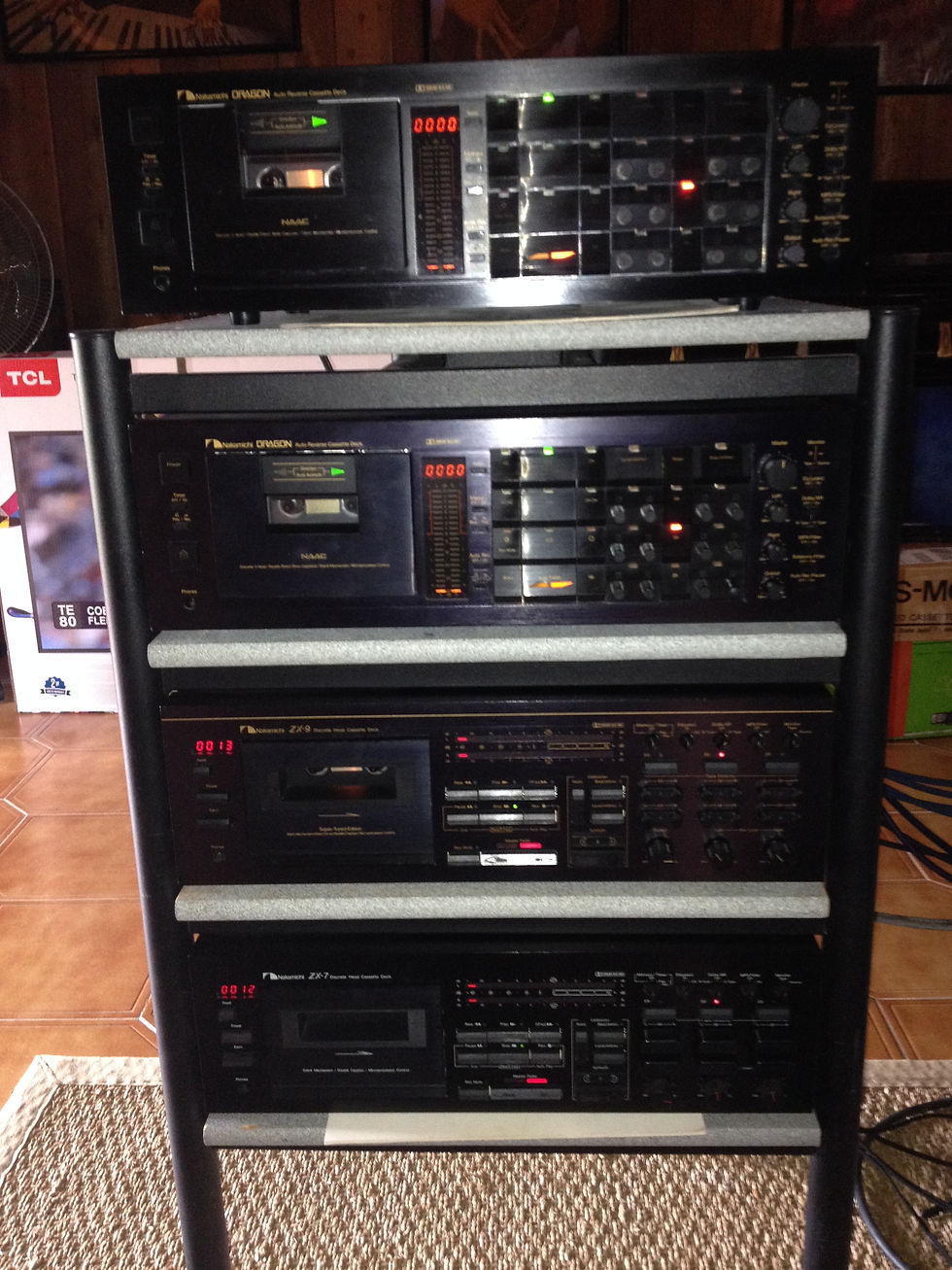
The Nakamichi Dragon: widely regarded as the most renowned cassette deck globally, it was named in honor of Nakamichi's founder Etsuro san and it was completed in time for a sample to be personally delivered to the hospital where Etsuro was, allowing him to witness his brand's pinnacle creation. Shortly thereafter, he passed away. The Dragon epitomizes the highest level of technological achievement in a cassette deck. It is an engineering marvel, crafted within such a compact space that it is truly remarkable. Nakamichi invested significant effort into perfecting tape "Playback," which became an obsession for them. They had been experimenting with auto-azimuth correction since the late 70s, initially with the record head, both automatically and manually. It was now time to ensure any tape, regardless of where it was recorded, sounded as intended by using Playback azimuth correction devices. These could be automatic, like the Dragon, or manual, like the CR 7. Unfortunately, the Dragon mechanism is so complex that even a normal maintenance session takes time, experience, special gadgets and it's not cheap. If you are lucky, you could get 5-7 years of operation again and even more if you are blessed. Nakamichi abandoned this complex mechanism for something more serviceable and less finicky like the RX 505 with its UDAR mechanism.
The usual debate surrounding the original DRAGON isn't as interesting as what this monster did represent in 1983 : it was the most one could do without actually altering the Compact Cassette format's physical structure like the ELCASET did (ie. open-reel in a cassette) or Luxman's X-3K prototype should have done by completely pulling the tape out of the cassette's shell thus removing any rotating movements from the tape.
(From The Vintage Knob).

The prices for refurbished Dragons are extremely high, with even units sold for parts surpassing $1,000. It's unbelievable! Avoid overpaying for these, as prices will eventually drop, which I've already noticed. Thankfully, the Dragon remains operational, modifications are available, and many units could last for years with proper servicing. Keep in mind that the Dragon's PBH is distinct and one-of-a-kind. If your playback head fails, you lose the NAAC capability. You can replace it with a "standard" head, but it will no longer support auto azimuth correction. This happened to me...
Before wrapping up with the "lady," I must emphasize that this machine ranks among the top tape recorders ever produced. We've highlighted its playback capabilities so extensively that some have mistakenly assumed its recording features aren't equally impressive. This notion is entirely false and unreasonable. It is still one of the best in terms of recording as well. If you're a dedicated Nakfan, it is essential for your collection. Period. More on the Dragon: https://mortechpr.wixsite.com/cassetteadventures/single-post/2015/09/23/the-fabled-nakamichi-dragon
The ZX's 7 & 9:

For numerous Nak enthusiasts, the ZX 9 is considered one of the brand's finest recorders. Featuring a quasi direct drive mechanism, comprehensive manual calibration, and a robust "all around" sound, the ZX 9 is a must-have for any dedicated Nakamichi collector. It's a "hot rod" upgrade from its predecessor, the ZX 7, and for just around $300.00 more, you could own the best! My unit was originally part of Nakamichi California's duplication facility. ESL liquidated all their equipment, restored the decks, and sold them later. One of those, came to my house.

The ZX 7 was introduced in 1981, alongside the 700 ZXE, 482 Z, 582 Z, 681 ZX, and 682 ZX. Most of these models were discontinued by Nakamichi a year later. With prices set at $1,250 for a "7" and $1,550 for a "9," it was evident that the brand aimed to cut production costs by avoiding auto alignment in many of their decks. During this period, Nakamichi established itself as the leader in cassette deck recording, but many models seemed nonsensical to consumers. Many were essentially the same, with only slight price differences, as seen in the ZX collection. From the 660 ZX to the TOL 682 ZX, they were practically the "same" machine with minor enhancements. This was likely their strategy to increase line depth and market presence with minimal changes and cost restrictions. More on the ZX 7: https://mortechpr.wixsite.com/cassetteadventures/single-post/2016/03/03/the-nakamichi-zx7
The Nakamichi RX 505 Recognizing the complexity and maintenance challenges of the Dragon NAAC's intricate transport system, Nakamichi devised an innovative auto-reverse technique that flips the tape without altering the playback azimuth. The UDAR mechanism is yet another brilliant creation from Nakamichi. The RX 505, the third and highest model in the "tape flipping" series, is essentially a ZX 7 in reverse. It's an impressive deck and a true visual marvel when it flips the tape side!

Possibly owing to its playback display, the 505 is often not recognized as a good recording deck. These are misconceptions propagated by critics or those who fail to appreciate it. It records just as effectively as any other Nakamichi deck, offering the same quality, excellence, and approach to addressing complex problems with simpler solutions. That's why Nakamichi was #1.
Vintage RX 505 units need servicing to function perfectly. Typical restoration tasks include replacing the drive belts, re-lubricating the transport tray mechanism, and occasionally replacing deteriorating capacitors (recapping) on the audio boards to restore high-frequency response.

Nakamichi CR 7 cassette deck introduced the brand's latest automatic calibration system and featured several other innovations. The microprocessor-driven auto-calibration process includes the standard record-sensitivity and bias adjustments, but also adds a key step for enhanced performance: the playback-head azimuth is automatically aligned with the record head to prevent misalignment from affecting high-end response. This allows the bias adjustments to accurately correct any response deviations. Combined with precise sensitivity adjustments, this ensures optimal Dolby NR tracking. The sound quality of this machine is outstanding. Having appreciated the recording quality of my ZX-7 and with the CR-7's manual azimuth adjustment allowing for precise fine-tuning, I can produce excellent-sounding dubs that rival CD to tape quality. It was the first one with an outsourced transport from Sankyo. Very good, indeed but it was also a sign that things were changing around in the Nakamichi headquarters.

I call it The Last of the Mohicans because it was the last "real Nak" coming out of Japan's. Some individuals believe that the CR-7A provides superior sound quality compared to the Dragon, while others hold a different view. In my opinion, each deck has its unique sound characteristics. I still have 2 Dragons and can confirm that the Dragon performs exceptionally well in the high-end frequency range, whereas the CR-7A is notable for its richer, more rounded low-end. Additionally, the Dragon's high-end frequency response is somewhat softer and more refined than that of the CR-7A. Ultimately, it comes down to which sound you prefer. More about the CR 7: https://mortechpr.wixsite.com/cassetteadventures/single-post/2016/03/07/the-cr7a-last-of-the-mohicans


The Nakamichi 682ZX is widely celebrated by audio enthusiasts as one of the most musical and beautiful cassette decks ever made. Audiophiles praise its deep, smooth bass and engaging soundstage, while its phosphorescent meters and classic design give it a striking vintage aesthetic. Nakamichi had several models in this 6xx range, starting from 660ZX and ending with famous 682ZX. Produced at the end of 70’s. these models were pretty expensive with price tag range from 995 to 1.800 USD.

This is what Zoki Audio has to say about the 680 ZX series: After having several Nakamichi decks, from cheap ones to some pretty expensive units, I must admit that every time I get surprised when listening to 680ZX and the rest from this series: their looks is specific and different from the others, their transport is also different but they don’t have so complicated electronics with exotic parts etc. But they sound so good, and this is the miracle and magic of Nakamichi decks. I must note that I am not a Nakamichi fan, I also like Revox, TEAC, Sony and other specific decks from different manufacturers. But I will tell you about them some other time. There you go...

The 680 and ZX’s pushed the +/-3dB HF performance to 22Khz, but possibly more importantly, LF went down to a low 10Hz. These models have the lowest usable LF response of all the Nakamichi’s, though I find them a bit ‘bloomy’ with certain recordings. All 3 decks are similar with some minor differences in performance and features, like 1/2 speed which makes no sense and it was rapidly abandoned, but the 682 ZX does not represents a totally superior performance over her other siblings. Still, remains the TOL of that series and its 1981 price tag confirms it: $1,800.00

The 680 ZX introduced in 1979, solidified Nakamichi as the real king of the audio cassette technology. The 1/2 speed fiasco proved that even at slower speeds it could provide a pleasant sound. Unfortunately, it has no practical use and was abandoned by 1981 when the 681 ZX and the 682 ZX showed up in the line, hardly lasting just one year. All 3 decks are basically the same and just a way to add more line depth without retooling the whole production line again. They did the same with the 1000 ZXL (limited) and 700 ZXL (700 ZXE) and with the ZX's as well (7 & 9)..


In total we have a few Naks around, all fully working and restored by Willy Hermann & Perry Esposito mostly. My actual list includes:
2 700 ZXE
2 Dragon
ZX 9
ZX 7
CR 7
RX 505
682 ZX
681 ZX
680 ZX
I'm actually looking to complete the 600 ZX's line with the 660 ZX & 670 ZX. I'm also interested in the 482Z and 582Z. That would be it as I'm no longer interested in ZXL's machines.
Other Tools:
I also have many other professional toys around, like this Studer A 807 mk ii, recently serviced by Jim Santoro of Reel Audio in North Carolina. I have done dubbings from this machine to any other cassette deck in the studio and the sound is simply amazing! The 807 comes with HX PRO already and running @ 15ips is on a totally different level of sound quality.

Do any Nakamichi decks sound as good as your open reel decks? Yes and no. Consider the Dragon, for instance. Not because it's the "best", but its NAAC mechanism ensures that 99% of the tapes played on it sound amazing due to its azimuth auto aligning. The Dragon is undoubtedly one of the finest cassette decks ever made and has been the go-to choice for audiophile recording enthusiasts. It was also favored by tape manufacturers of the time, who used a modified Dragon to analyze their tapes! If you compare the Dragon with a Metal TDK tape and a high-quality recording against a basic 1/4" tape running at 7.5 ips in the domestic quarter track format, you'll be impressed. It outperforms many older models like Teac, Sony, Akai, etc. However, when you step into the professional realm with competitors like Studer, Otari, Ampex on 1/2 track, the situation changes. In the 1/2 track format, even at 7.5 ips, the Dragon can't compete, but it still makes you think. Increase the speed to 15 ips, and it's game over. There's no chance, but this highlights the cassette's charm: running at 1 7/8 ips, in limited space, with quarter track, more complex mechanics, and less robustness, it can rival machines with far greater capabilities, like reel-to-reel decks.

The Nakamichi legacy traces back to the 1940s when Etsuro worked as a radar technician during WWII. His passion for magnetic media recording drove him to explore and innovate in the realm of audio tape. No one else in the industry delved as deeply into a single obsession as the Nakamichi brothers did. This intense focus became a double-edged sword, confining their research and efforts almost exclusively to cassette media. By the time the digital revolution arrived in the 1980s, they struggled to adapt their philosophy to the new era. Frankly, I don't think it was merely a slow response that led to Nakamichi's decline. The Nakamichi brand was built around cassette deck technology, consistently showcased in vibrant ads featuring their machines in Stereo Review and other publications. They established their reputation on unmatched cassette tape playback capabilities. Suddenly, they began promoting their ability to make other products, but it was too late, as the competition had become fierce. In the cassette tape domain, Nakamichi was the undisputed leader, but this was not the case in the digital arena. The constant overpricing of their products no longer equated to quality, as other companies offered better alternatives for less. Additionally, the new "digital wonder" known as the CD offered superior sound quality, convenience, and eliminated issues like tape spills or cassettes getting stuck in car audio systems.

The peak year for cassette sales was 1990, with over 450 million units sold. In 1991, CDs surpassed cassettes and all other formats in sales for the first time. By 1993, cassette sales had decreased by 7%, and by 1995, companies like Nakamichi and others moved their production out of Japan. Niro assured that the foreign plants were supervised by Nakamichi employees personally. What Niro said about this:
“Quality variation was never an issue. Towards the end, the high labour costs made it impossible to produce some of the budget models in Japan, and production was transferred to Malaysia and Singapore. But these were proper Nakamichi factories, supervised by engineers sent from Japan, and this ensured that the quality was maintained. Actually, the only quality problems we found were with some of the cheaper CD Players, where the soldering was not so precise. 1996 was the last year of production of the DR-Series, and then things went quiet for a while. There was a brief reincarnation in 1999 in the form of the DR-8 and DR-10, but this only lasted for about eighteen months. No cassette decks have been built since.”
By the mid-1990s, CD sales had reached billions, and cassette sales declined more rapidly than expected. The last notable year for cassette sales, often seen as a "brief resurgence," was 1997, with surprisingly high sales figures. This marked the end of the cassette era. After 1998, our tape bin loops were gathering dust while the CD presses were running 24 hours a day, 5 days a week, and even more during peak seasons. Our beloved cassette tape, with all the remarkable engineering efforts by many talented individuals who transformed what was once called a "spoken word" medium into a high-end contender in the audio field, was finally gone... Once the new century began, nobody wanted to use tapes anymore, and many machines were discarded or sold for very low prices. This is how I managed to buy Dragons for $80.00 and 505 for $50.00. Those professional machines were also available for peanuts or simply FREE, with no interest from anyone to use them. Thankfully, enthusiasts like us never abandoned the analog tape and keep it alive even today, where machines over 50 years old still perform excellently and continue to endure!

Do I have other favorite decks? Absolutely! I've always been a devoted fan of Studer Revox and purchased a brand new B 215 in the 80s. Ever since then, I've consistently had one in my collection. The NAD 6300 is an impressive deck, utilizing the same mechanism as the Nak CR 7, a Sankyo, and for its price, it was a strong competitor. I used to own two of them. It was a deck you could acquire for next to nothing, but once we discussed it on Tapeheads, the price tripled in just a few days!

The Teac Z 7000 from the Z Series is a remarkable achievement by Teac. Ultimately, many of these treasures were produced by subcontractors, such as the major Japanese OEM manufacturer Kurume Denshi Kogyo, which Teac and Denon used! In Nakamichi's case, compared to other Japanese giants, it is a relatively small company. All the research was conducted in-house, along with some specific parts, like the exceptional heads they created, which were the best ever and contributed to the legendary Nakamichi "color" and extended frequency response.

Sony, Technics, Pioneer, Teac, Akai, ATC, Tandberg, NAD, Harman Kardon, Aiwa... you name it. They all offered very good decks for much less (with a few exceptions) and good sound, but none could ever match Nakamichi's engineering brilliance. Their 3-head design was used and copied by many, with an extended frequency response never seen before and a very distinctive "color" without the need for HX PRO. These were just a few of Nakamichi's advancements, with the Dragon being their best seller ever and the most iconic cassette deck in the world. The real and most significant advancements in cassette decks were developed by Nakamichi. Period.
Finally, always remember: there is no "best." The best is in the eye of the beholder. It's up to the end user
because the "best" cassette deck is the one you listen to and can keep it running.

About the author:

Carlitos Guzmán, known as El Magnifico on Tapeheads, is a Grammy-winning Mastering Engineer and a vintage audio enthusiast with the largest tape deck collection in his native Puerto Rico. He was formerly the president of Copytech Corporation and CopyTech Mastering Services in the 1990s. Copytech was the leading cassette and CD duplicator in the Caribbean. Although duplication ended in 2003, he continues to provide mastering services for a select group of clients. His collection is entirely "practical" and fully operational, as he does not maintain museum pieces. The units are organized into various systems throughout his home, with specific areas dedicated to his Nakamichi and Revox collections. He has two sons: Carlitos Jr, a Lieutenant Commander in the Navy, and William, a Data Bricks Architect. He has one grandson, Liam. He resides in Luquillo, PR with his wife Carolyn, along with their cats and dogs.
.


Comments